Simulator

PaleBlue ROV Trainer

An IMCA Class-A certified ROV simulator used in Module 9 — ROV Simulation, to train piloting, thruster control, and fault handling before participants move on to real field practice.

What Is the PaleBlue Simulator?

The PaleBlue ROV Trainer is an ROV simulator that has obtained IMCA Class-A certification, in accordance with IMCA C014 (Guidance on the Use of Simulators) and IMCA R028 (Requirements for IMCA Approval of Class-A ROV Simulators). With this Class-A status, the training hours participants log on the simulator can be recognized as part of the evidence portfolio for meeting IMCA R002/R025 simulator-based training requirements.

At NextNusa, this simulator is used in Module 9: ROV Simulation (Level 3) — 3 days of training split into 6 sessions, led by instructors experienced in ROV piloting.

PaleBlue Subsea Developed by PaleBlue Subsea — used by defence and educational institutions across multiple countries.
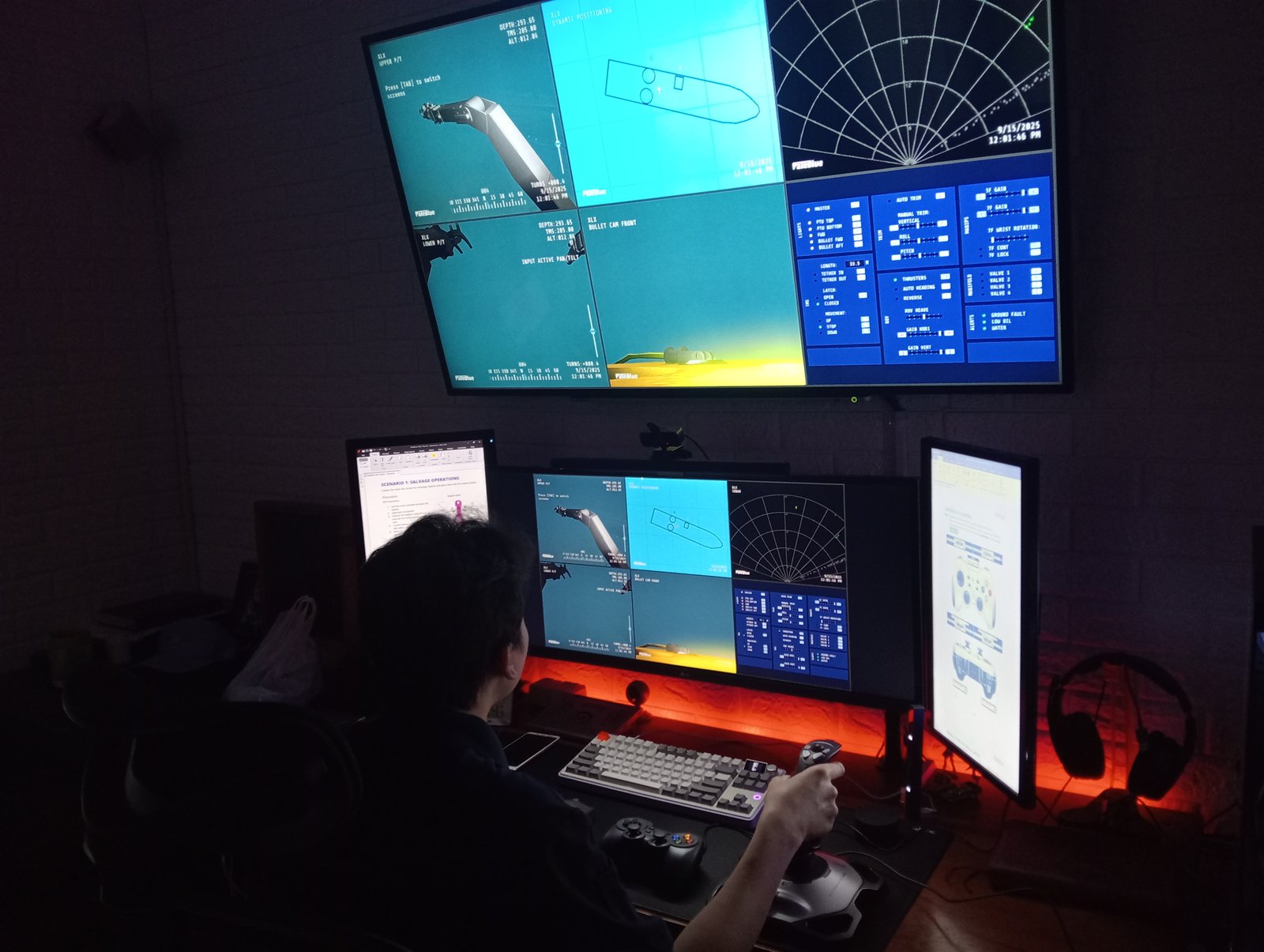
Illustration of the PaleBlue ROV Trainer simulator

Key Features

Certification
IMCA Class-A Certified

Recognized against the Class-A simulator criteria in IMCA R028 — simulator hours count toward the competency evidence portfolio.

Control
6 Degrees-of-Freedom Piloting

Surge, sway, heave, yaw, pitch, roll — thruster control response that represents real ROV handling.

Scenario
Fault Handling & Emergency Drill

System fault simulation, emergency procedures, and mission abort — practiced in the simulated environment before facing real conditions.

Operating Condition
Low-Visibility Simulation

Practicing maneuvers and obstacle avoidance under limited-visibility conditions, closely mirroring field operation challenges.

Setup
Flexible Setup

Available in single-pilot, two-pilot, and instructor station configurations — adapted to the needs of each training session.

Instructor Control
Real-Time Instructor Control

Instructors can control crane conditions, vessel movement, the environment (visibility, heave, current), and trigger faults & alarms in real time during a session.

ROV Models Supported by the Platform

The PaleBlue ROV Trainer supports a range of ROV classes — from Small Class to Work Class — letting participants train on models relevant to their operational needs.

Small Class
BlueROV2

The same unit NextNusa uses for real field practice.

Small Class
Chasing M2
Small Class
Deep Trekker
Observation Class
Saab Falcon
Work Class
Hytec H2000
Work Class
Triton XLX

Additional ROV models are available on request. NextNusa currently trains participants specifically on the BlueROV2 for field practice (Module 12).


Offshore Job Scenario Practice

Beyond basic piloting drills, the PaleBlue ROV Trainer also features scenarios that represent work commonly faced by ROV pilots offshore — so participants are already familiar with real work situations before being deployed to an actual site.

Inspection
Visual Inspection of Subsea Structures & Pipelines

Maneuvering the ROV to check the condition of a subsea structure or pipeline, similar to routine inspection work in the field.

Navigation
Navigating to a Work Site

Simulating the ROV's journey from a starting point to a work location (point-to-point), including obstacle avoidance along the way.

Field Conditions
Operating in Low Visibility

Maneuvering in murky water or low-light conditions — a situation commonly encountered in real subsea operations.

Emergency
Emergency Response

Identifying faults and deciding on a mission abort according to emergency scenarios that can occur in the field.


Training Scenarios & Sessions (Module 9)

6 progressive sessions, 4 hours each, referencing IMCA C014 / R028:

Session 1
Basic Piloting

Basic control across 6 degrees of freedom (surge, sway, heave, yaw, pitch, roll).

Session 2
Thruster Control & Stability

Stable maneuvering and hovering using thruster control.

Session 3
Holding Depth & Heading

Maintaining ROV depth and heading in a controlled manner.

Session 4
Maneuvering in Low Visibility

Maneuvering and avoiding obstacles under low-visibility conditions.

Session 5
Simple Mission Practice

Point-to-point navigation and simple object inspection.

Session 6
Basic Fault Handling

Fault identification, emergency procedures, and mission abort.

View Full Program Structure Ask Admin About Schedule